AI Picked the First Store and the Other Four Vanished: WeChat's New Shelf for 10 Million Merchants
First piece in the series WeChat's AI Entry: Rebuilding the Merchant Agent. Three questions, three posts — how to get found, how to keep your customers, how to rebuild. This one answers only the first, and the one that bites soonest: when the AI makes the choice, can your store still be seen at all. Context in one line: WeChat is beta-testing an AI agent that lives in the top-left corner, can be triggered inside chats, articles, Channels videos, and mini-programs, and can search, compare, order, and pay across ~10 million merchants. The capability is still under compliance review and the contract isn't frozen — so this post doesn't dissect an API, it shows you how the rules changed. The engineering deep-dive is in the third piece, The Day WeChat's AI Ordered for Users, 10 Million Merchants' Mini-Programs Expired.
1. The AI picked the first one, the rest vanished — the shelf changed
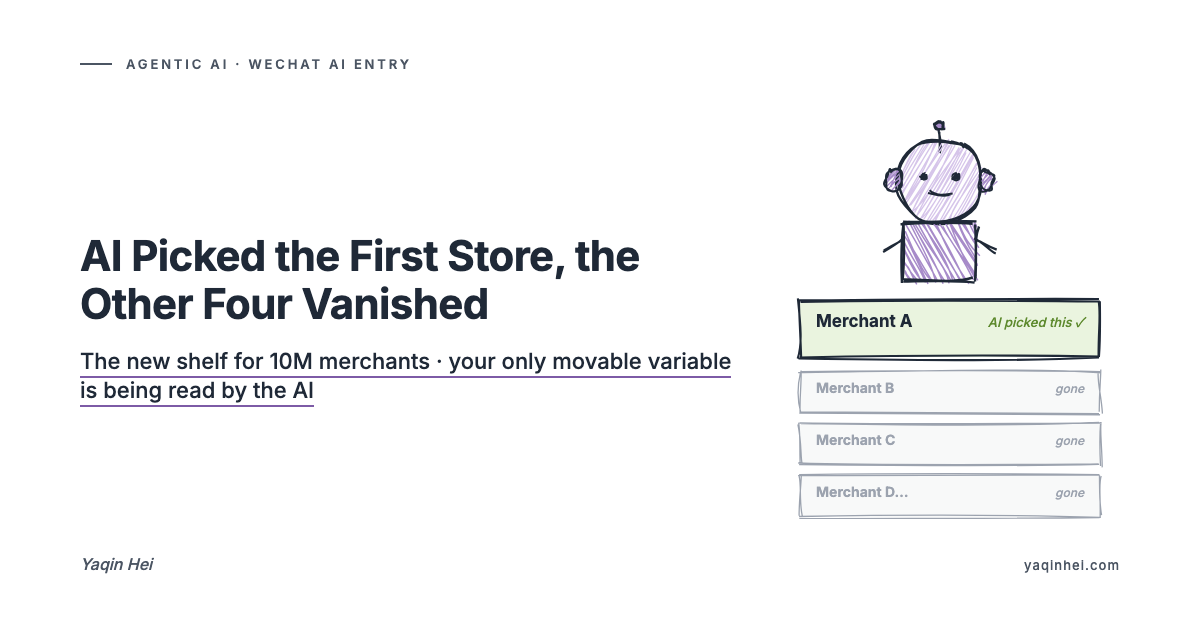
Start with something real. A reviewer with beta access asked the agent to book a movie ticket. His words: "It listed 5 mini-programs, picked the first one — Maoyan — drove it all the way to the theater-selection step, and handed the rest to me."
Read that three times. The AI listed 5 merchants, picked one, and the other 4 — for this transaction — ceased to exist. The user never saw their names, never compared prices, never hesitated, never even made the "let me scroll a bit more" motion.
That's not ranking low. That's falling off the shelf.
Let's put the conclusion on the table first: the physics of traffic distribution changed, and merchants that survived on "the user glancing one more time" get zero glances in the new world.
The old shelf was a scrolling page of search results. The user types "latte nearby," the platform returns a list, they thumb through three screens, spot a cheaper one at #8, and tap in. Ranking #8 still fed you, because the user's eyes swept past you.
The new shelf is what's left after the AI reads every candidate and makes the decision for the user: it executes exactly one result. It doesn't scroll, doesn't waver, doesn't give #8 a chance. Whoever gets picked owns the transaction; everyone else gets not a single impression.
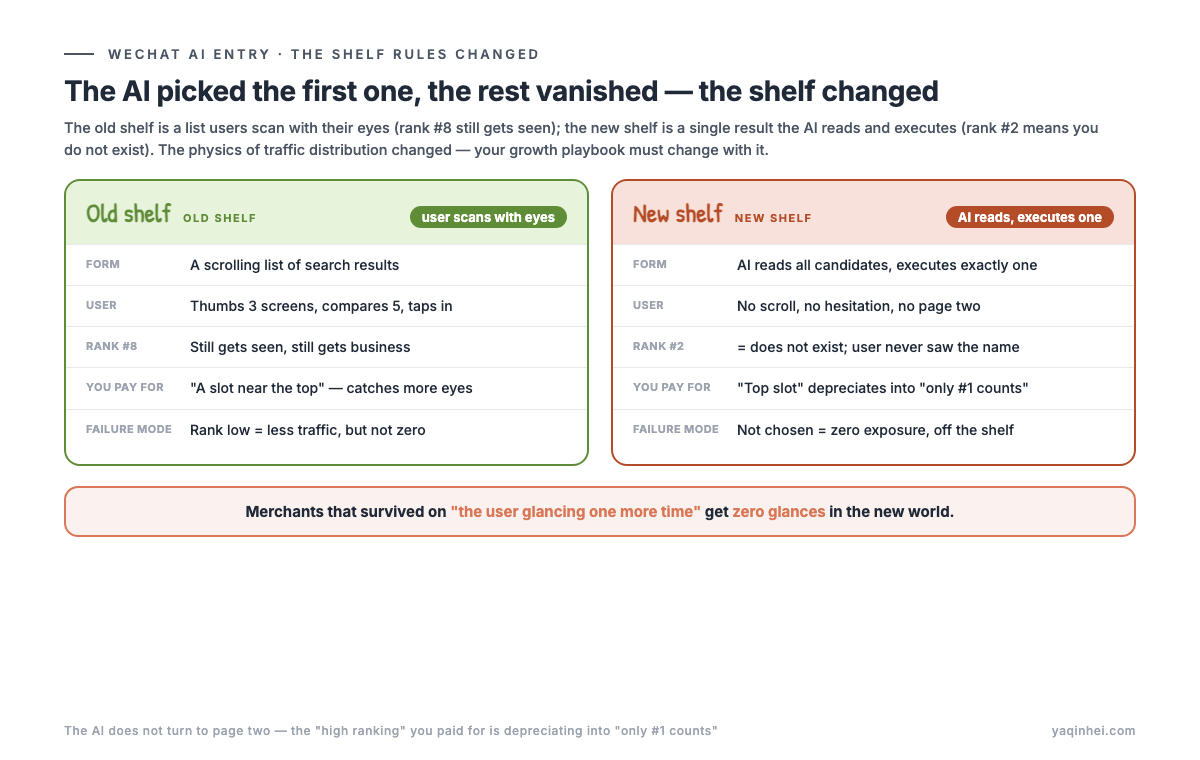
For an owner, that's a cold fact: the "high ranking" you used to pay for is depreciating into "only #1 counts." Not alarmism — it's what the shelf's structure dictates. The AI doesn't turn to page two.
2. You're not fighting rivals for rank — you're fighting a black box to be understood
In the old world you knew exactly who you were fighting: same-category rivals, over keywords, ratings, price, ad budget. Expensive, but transparent — you knew more money bought a higher slot.
In the new world you face a black box. You don't know why the AI ranked those 5 in that order, and you don't know why you weren't in the 5 at all.
Conclusion first: old SEO/ASO fought for "rank in human eyes"; the new rule fights for "readability in the AI's head" — if the AI can't read what you do, you don't even make the candidate list.
I pulled WeChat's published skill docs and read them, and the first clue about this black box is buried in there: triggering is scoped by scenario. The official trigger scenarios for mini-programs are a short list — local-life ordering, ride-hailing, movie tickets, lookups, top-ups. In other words, the AI doesn't rank you against "all merchants." It first maps the user's sentence to a scenario, then picks among that scenario's candidates.
That clue matters because it tells you exactly how failure happens:
- If the AI can't map your service into any scenario, you're not ranked #100 — you never made the table. No promo, no rating saves you; the AI won't even look.
- If you barely make a scenario but the AI reads your capability declaration as vague and mushy, it ranks you behind the rival it can read clearly.
So the real axis of competition quietly shifted from "I'm cheaper / rated higher than rivals" to "can the AI understand, at a glance, exactly what task I can complete." That's not a marketing problem — it's whether your service is machine-readable. Most merchants have no idea what they even look like in the AI's eyes — and that's the black box's real danger: you're bleeding, and nothing shows on the dashboard.
3. Why would WeChat push you and not someone else? Three levers — which one can you move
Crack the box open and the AI's ranking is shaped by roughly three forces. Knowing which you can move and which you can't is the prerequisite to spending budget in the right place.
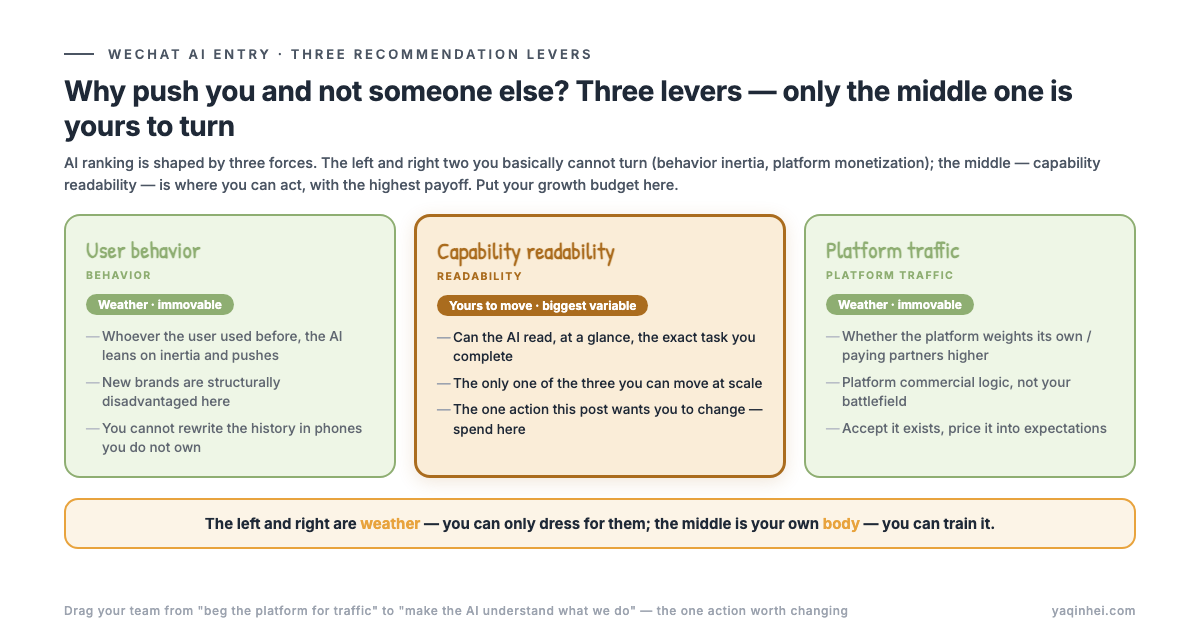
Lever one: user behavior and history. The user used Maoyan before, so the AI leans on inertia and pushes Maoyan. This force is real, but you basically can't move it — you can't rewrite the history in someone else's phone. New brands are structurally disadvantaged here; fighting it head-on is pointless.
Lever two: your capability readability. Whether the AI can accurately read that "this store cleanly completes screening, seat pick, and payment in the 'book movie ticket' scenario." This one you can move — and it's the only one of the three you can move at scale. The rest of this post is about it.
Lever three: the platform's own traffic and monetization. Whether the platform weights its own business and paying partners higher — that's the platform's commercial logic, also immovable. Accept that it exists and price it into your expectations.
The takeaway is blunt: levers one and three are weather — you can only dress for them; lever two is your own body — you can train it. Drag your growth team's energy away from "how do we beg the platform for more traffic" back to "how do we make the AI understand, at a glance, what we can do." That's the one thing this post wants you to change.
4. The only variable you can move: make the AI understand you at a glance — mcp.json is the new SEO
So where does "make the AI understand you" actually land? On a capability declaration written for the AI to read. In WeChat's dev mode it's called mcp.json — it declares, one by one, what your store can do, what parameters each thing needs, what it returns.
In the old era, writing SEO meant piling keywords for humans to read while gaming the search engine for weight. In the new era, writing a capability declaration means telling the AI, precisely, "here's what I can complete" — so it recalls you in the right scenario and dares to hand you the transaction. Here's what a real declaration looks like (structure from WeChat's official sample project WeStoreCafe, details adapted to your business):
{
  "name": "searchDrinks",
  "description": "Search orderable drinks in this store's menu by keyword; call when the user names a drink or category.",
  "inputSchema": {
    "type": "object",
    "properties": {
      "keyword": {
        "type": "string",
        "description": "The drink name or category from the user's own words; never invent items the store doesn't carry"
      }
    },
    "required": ["keyword"]
  }
}
Don't let the JSON scare you — as an owner you only need to read that description. It does two things: it tells the AI "I can work inside the 'search-a-drink-and-order' scenario," and it draws a boundary: "only search what the store actually carries, don't make things up." Write that clearly and the AI recalls you when the user says "get me a latte"; write it vague and the AI skips you for the rival who spelled it out.
That's the essence of the new SEO: not piling words for humans, but telling the machine — precisely — what you can and can't do. One rule of thumb: every "I can do this" you leave out is one fewer reason for the AI to push you; every gray area you leave in is one more excuse for it to rank you lower.
Feel the difference. Same coffee shop, two ways of writing it:
| Approach | description | What the AI reads |
|---|---|---|
| Old-SEO instinct (for humans) | "Artisan specialty coffee, the coffee expert by your side" | An ad slogan, maps to no ordering scenario, skip |
| New-rule instinct (for the AI) | "Search and directly order in-stock drinks by name or category; supports sugar-free, milk swaps, extra shots" | Clearly in the 'search-drink → order' scenario, boundary is crisp, recall |
Your marketing team can write ten versions of the left one, and the AI can't use a single word of it; the right one isn't pretty, but it gets you onto the candidate list. The good news: this doesn't require rewriting your mini-program — it's a "manual for the AI" layered on top of your existing business. The bad news: almost no merchant is writing that manual carefully yet — which is exactly the window you can still grab.
5. Auto mode gets you "found," dev mode gets you "chosen"
WeChat offers two integration modes. As an owner you don't need the technical detail — just what each one buys.
Auto mode: you authorize the platform to read your mini-program's source at review time, it analyzes your page structure itself, and lets the AI operate your existing pages directly. The value is fast, near-zero dev — it buys an entry ticket that answers the life-or-death question: "can my service even be searched and seen by the AI."
Dev mode: you package your core capability into a standardized SKILL, explicitly declaring interfaces, parameters, rules, so the AI calls it with more certainty. It needs dev work and review, and it buys conversion quality — once found, whether the AI dares and manages to close the transaction cleanly on your side.
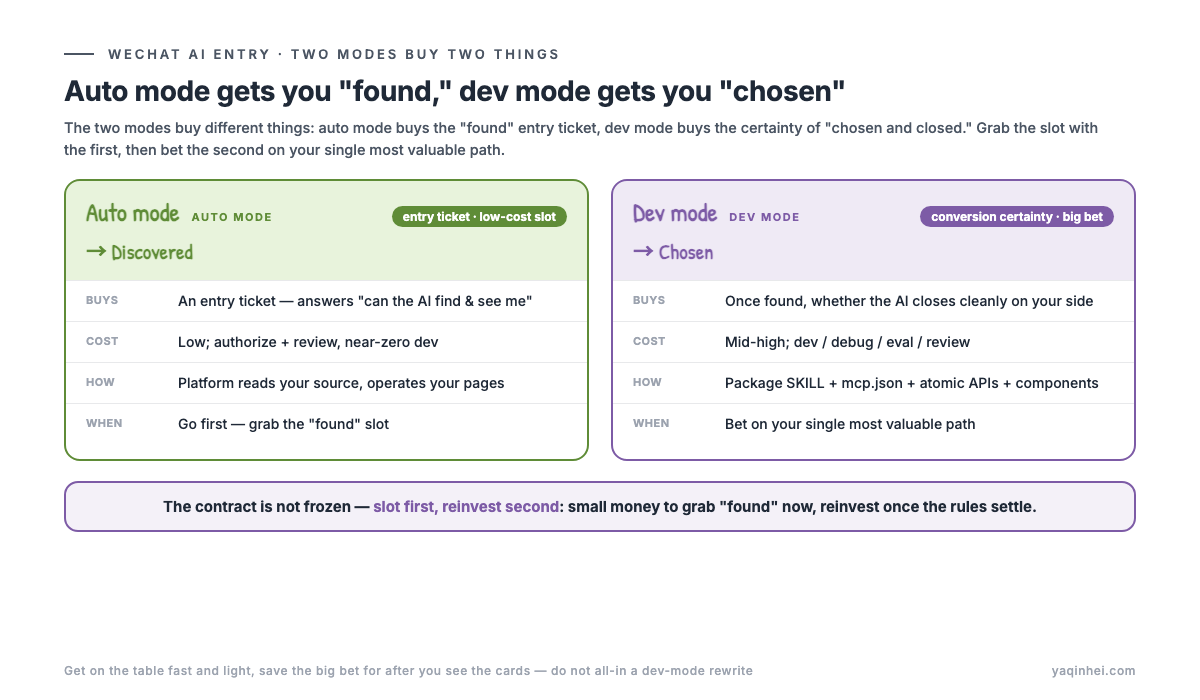
For a growth lead, the sequencing is one sentence: use auto mode first to cheaply validate "can I be found," then decide which high-value path is worth dev mode to fight for "chosen."
Why that order? Because the contract isn't frozen. WeChat is in beta — APIs, review standards, entry naming all may change. All-in-ing your budget on a dev-mode rewrite right now is betting on an interface that's still moving. Auto mode is cheap enough to buy as an option — small money to grab the "found" slot now, then reinvest once the rules settle. Slot first, reinvest second.
6. Is your service already invisible to the AI? 3 signals + 5 questions worth asking
Enough about black boxes and shelves. On the desk, what you need is something you can self-check right now.
First, 3 signals that "you're going invisible to the AI" — one hit and you should worry:
- Your mini-program is all images and custom rendering, with nowhere a structured statement of "what I can do." The AI reads your source and finds a pile of visual elements, mapping to no scenario — to it, you're an unreadable picture.
- Your core service is scattered across seven or eight pages, and you can't say one sentence of the form "when the user says ______, I complete ______." If you can't state "one sentence → one task," the AI can't line you up against any user intent.
- Almost all your recent new users came from paid ads and campaigns, with no organic "searched, recommended" inflow. You've been surviving on bought impressions; swap the entry to an AI and your old money buys nothing on the new shelf — you're running naked.
Then, 5 questions to put to your platform / team next week — anyone who can't answer or gets shifty is pointing at exactly where the problem is:
- "If a user says our core service out loud in chat, can the AI find us right now?" Nobody on the team can answer → nobody's watching this, which is itself the biggest risk.
- "After an auto-mode review reads our source, which core capabilities can the platform identify?" "Not sure" → your AI-readability is a mystery; go measure it.
- "Which single path is worth dev mode, to fight for 'chosen' rather than merely 'found'?" "All of them" → your budget will burn; bet only the single most valuable one.
- "Are our capability declarations / product descriptions written for humans or for the AI to read?" "For humans" → they do almost nothing on the new shelf; rewrite a version for the machine.
- "If the AI only pushes the first one, why are we the first — behavior inertia, capability readability, or platform traffic?" Can't say which you're betting on → back to section 3, and put the bet on the one lever you can move: readability.
Question 5 belongs on your growth team's wall. It forces you to admit one thing: on a shelf that only pushes #1, "roughly near the top" is no longer a business.
After this piece
If you want the "old shelf vs new shelf comparison + three-lever map + a 3-signal self-check + a 5-question card" dropped straight into your next growth / strategy meeting — instead of re-reading this each time — I put together a PDF kit for readers who made it this far. Send me the keyword "VISIBILITY KIT" and I'll send it over:
- Old-shelf vs new-shelf comparison (one page on how traffic distribution changed)
- Three-lever map (behavior / readability / platform traffic, marking which one you can turn)
- "Invisible to the AI" 3-signal self-check (tick each; how many you hit is obvious at a glance)
- 5-question card (for the meeting: answered / shifty / blank, three colors)
The next piece answers the second question — once the AI becomes your storefront, do you still know your own customers. Grabbing the shelf slot is only the start; the real danger is who owns the customer after the sale — the AI, or you.
(Channels are in the footer — X or email both work.)
Building an agent right now?
Send me your worst conversation. Free failure teardown.
Comments
Subscribe
Get the next essay in your inbox.