Your Knowledge Center Is a Search Box
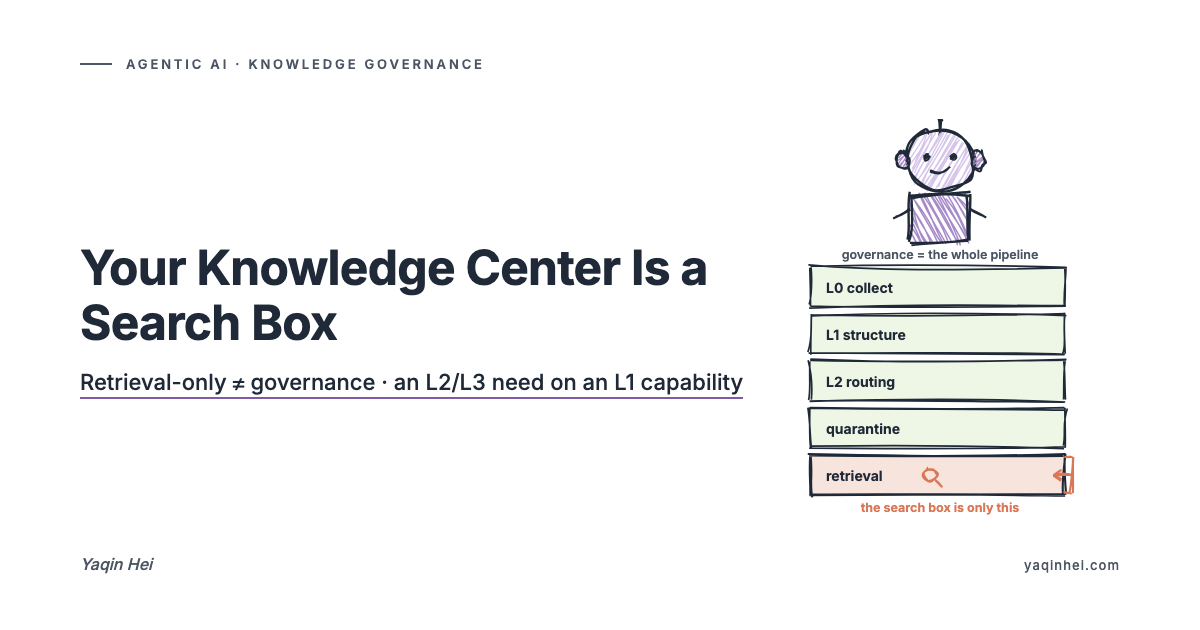
The 15th piece in the Agentic AI in Practice series. Earlier pieces covered grading a project and gating a launch; this one is about a procurement trap almost every agent project hits — you think you bought a "knowledge center," but you bought a search box. 中文版:你买的是知识中心,还是一个搜索框?.
The demo answers instantly, and the boss signs off on the spot
In the procurement meeting a vendor demos an "enterprise knowledge center": type "how do 7-day no-reason returns work" into the search box, and the screen fires back a neatly formatted policy paragraph with the key sentence highlighted. The boss is sold — "we'll take it." Three months later the agent project team sits in a room and ends up standing up a separate knowledge-governance service — because the "knowledge center" they signed off on can't feed a working agent.
It's an awkward scene, because the demo really was good — ask anything, get an answer, fast and accurate. But wire it into an agent and the problems surface in layers: the agent needs "should this order get a price adjustment, and how much," and all it gets is a "return policy excerpt"; the business edits a policy and production still quotes the old line three days later; you were told 200 items were ingested and production counts a hundred-and-something, with nothing flagging the gap.
What broke the room's silence that day was a small confrontation. The business lead pointed at a conversation and asked "where did this price-match wording come from," and after digging, engineering found the agent had answered with a version of the policy that had been retired three weeks earlier — the business had updated it, but inside that "knowledge center" the old entry and the new one lay side by side, neither marked "expired," and retrieval happily surfaced the old one. Someone asked "can we make it only search the version that's currently in force," and the answer was no — because that search box has no concept of "version," "expired," or "in force." That's the moment everyone realized: to let an agent use knowledge safely, what's missing isn't a better search box — it's the entire governance pipeline that's supposed to sit in front of it, and that nobody built.
Trace all of it down and it's the same root: that's not a knowledge-governance system, it's a search box. Retrieval is only the last step of a knowledge lifecycle — "surface it"; the earlier work — take it in, structure it, make it routable, judgeable, retirable — a search box does none of it.
That's the procurement gap this piece is about, in one line: retrieval-only is not knowledge governance. You spent an L2/L3 budget and wired in an L1 capability.
Below, that gap broken into four real pitfalls — each one "gorgeous demo, can't feed the agent in production" — closing with a checklist you can carry into the procurement and acceptance meetings.
Retrieval is memory, execution is hands — which does your case need?
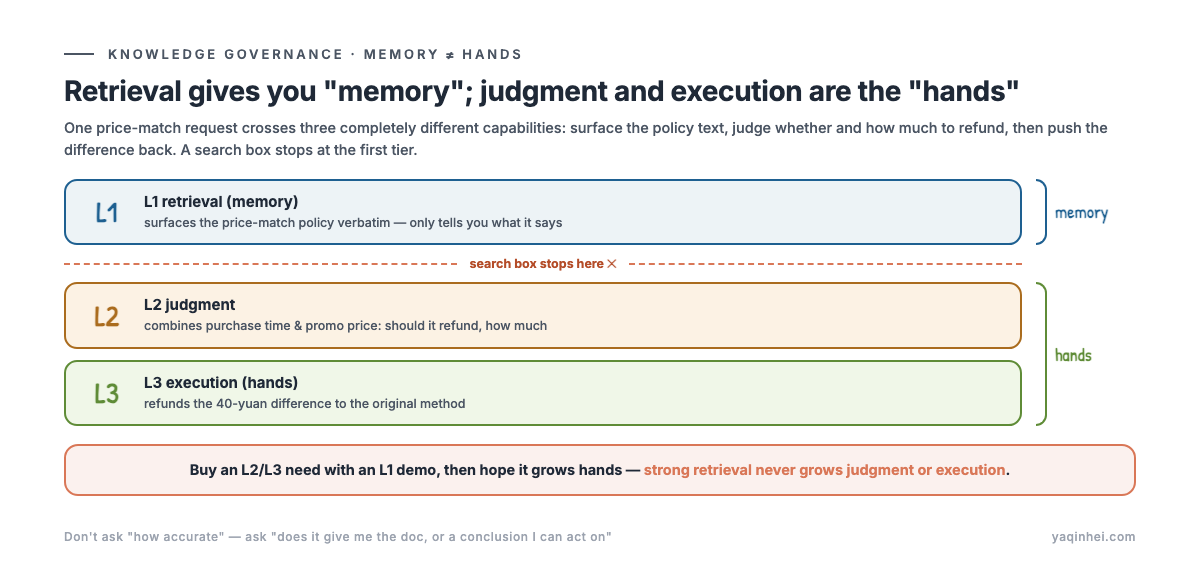
Put the most expensive misjudgment on the table first: a retrieve-only knowledge center is the agent's memory, not its hands. If you need the agent to judge and act but wire in a center that only "surfaces a paragraph," you're using an L1 capability to cover an L2/L3 need.
One scenario makes the difference obvious. A user asks "can I get a price adjustment on this order." A retrieval-type center can pull up the "price-match policy" document verbatim — that's memory, it tells you "what the policy says." But what the agent actually has to do is combine this order's purchase time, payment channel, and whether it was a promo or list price, judge "should this order get a refund, and how much," maybe even issue the refund directly — that's hands, execution. Memory and hands sit two capability tiers apart.
Lay that difference bare and it stings more: the search box returns "price protection requires application within 15 days of purchase, same item same price" — and then nothing. It hands the "so what do I do" straight back to the user, i.e. makes them cross-check their own order and do the math. But asking the agent is precisely a request not to do that math. The answer that actually lands is "your order was bought at the promo price 3 days ago, it qualifies, the 40-yuan difference will be refunded to the original method" — and in that sentence, the purchase time, promo price, difference, and refund action are none of them "searched." They're all judged and executed outside retrieval. The search box gives you the first sentence; your project needs the second.
Knowledge isn't a pile of documents — it's a pipeline from "taken in" to "usable"
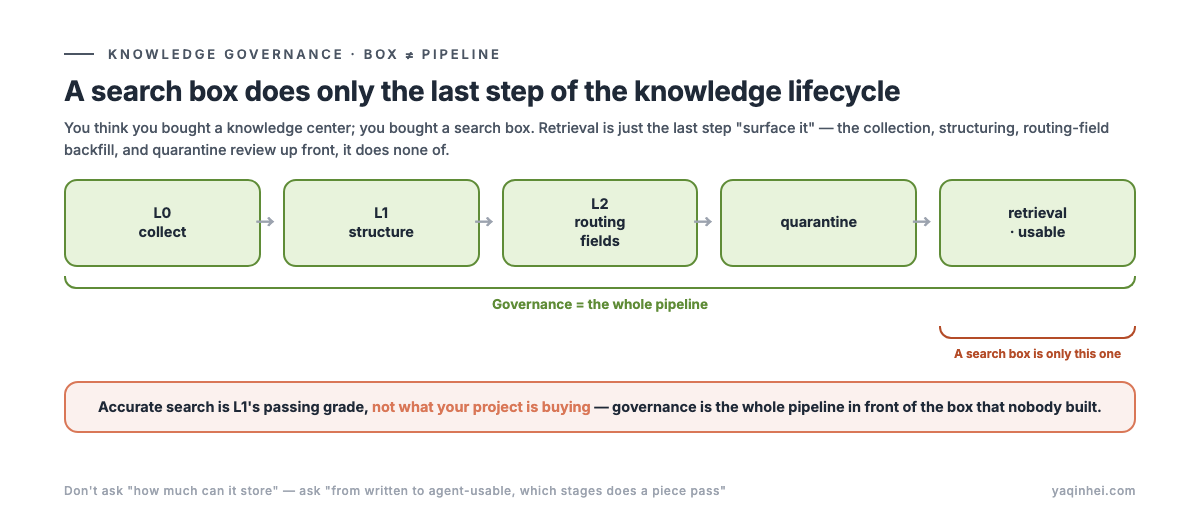
Governance is a pipeline that processes knowledge from "raw material" to "agent-usable," and a search box does only the last step, "search." The collection, structuring, routing-field backfill, and quarantine review up front — nobody does them. That's exactly why that team was forced to build a separate governance service.
The service they were forced to build was, at its core, a four-lane funnel: raw entries come in (L0) → cleaned and structured (L1) → backfilled with the fields that make them routable and judgeable (L2) → and only then into the retrieval index, "usable." The search box skips the first three lanes entirely, assuming "whatever you loaded is usable." But real knowledge, when loaded, is nothing like usable.
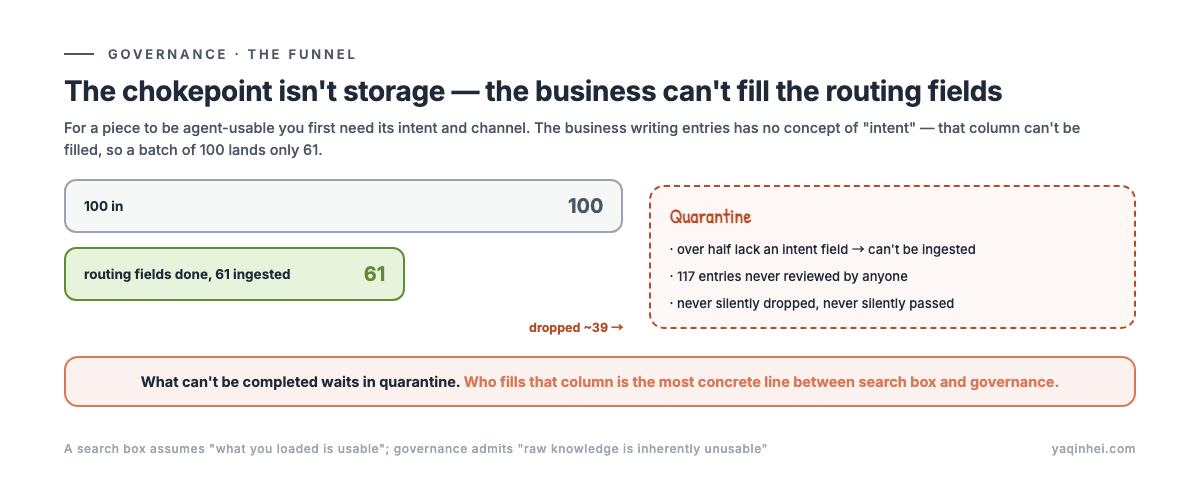
The hardest chokepoint isn't storage — it's that the business can't fill in the routing fields. For a piece of knowledge to be agent-usable, you first have to know which intent, which channel, which decision branch it belongs to — but the business people writing these entries have no concept of "intent," they only write "this is the price-match explanation." Once, asking the business to backfill the intent field on a batch, the person stared at that "intent" column for half a minute and asked "what do I put here? I just know it's about price protection" — their world is organized by "business topic," not by the agent's "intent routing." That column can't be filled not because they're careless, but because the field shouldn't be filled by someone who doesn't understand routing. The result: a batch of 100 entries comes in, only 61 get their routing fields completed and make it into the index; across the whole set, more than half the entries can't be ingested at all for want of an intent field; and 117 more have never been reviewed by anyone — neither used nor discarded, just hanging.
This is exactly the watershed between a search box and a governance service: the search box assumes "what you loaded is usable" and hands the dirty work of backfilling fields to the business by default; the governance service admits "raw knowledge is inherently unusable" and treats structuring and routing-field backfill as a pipeline stage that someone must own — done by people who understand the intent taxonomy, or by a semi-automated mapping, not dumped on whoever wrote the doc. Who fills that column is the most concrete architectural line between "search box" and "governance."
Small talk retrieves a policy: one fallback default lets "you there?" quote official terms
Retrieval's default behavior is fail-open — when it can't find anything strongly relevant, it hands you back the "most similar" anyway. So even a "you there?" can retrieve a policy document, and the agent quotes it, straight-faced, as the official line.
This pitfall hides deep, because it never shows up in the demo — in a demo you ask proper questions, and proper questions retrieve fine. What blows up are the inputs that shouldn't hit any policy: small talk, greetings, an offhand line.
Pull the real routing log and it's clear: the system has a layer that judges "does this qualify as an official policy line," and of 1834 candidate answers, 1732 were passed indiscriminately up to "usable as the official line" — because that layer's default is a fallback, a single or "layer1" in the code, dumping whatever was retrieved into the top tier. Meaning over 90% of retrieval results, the agent could quote to a user as policy. A "you there?" that so much as grazes the semantic edge of some policy gets retrieved, passed, and quoted.
Why is 90%-pass dangerous? Look at the cost of a wrong answer. A policy line isn't small talk — it's "can I return this," "how much refunded," "when does it arrive," the kind of thing a user acts on and complains about. A search box, when "unsure," leans toward making up something plausible, and in the policy setting a fabricated "free shipping over 99" or "returnable within 7 days," believed and acted on, is real complaints and real financial loss. Retrieval's default goodwill — always give you an answer — is exactly the poison here.
The fix isn't a new model — it's flipping that fallback from fail-open to fail-closed: what can't clear the relevance bar gets "I can't answer that yet, routing to a human" rather than a scraped-together policy. After the change, of the 1834, only two-hundred-something actually qualify as a policy line — 90% of the "fake official lines" fenced out.
A line worth pinning to the wall: retrieval's silent-failure direction is fail-open, and the policy setting needs precisely fail-closed. A retrieve-only knowledge center defaults to "cover for you with some answer," but in refunds and policy, "invent a presentable answer" is far more dangerous than "honestly say I don't know."
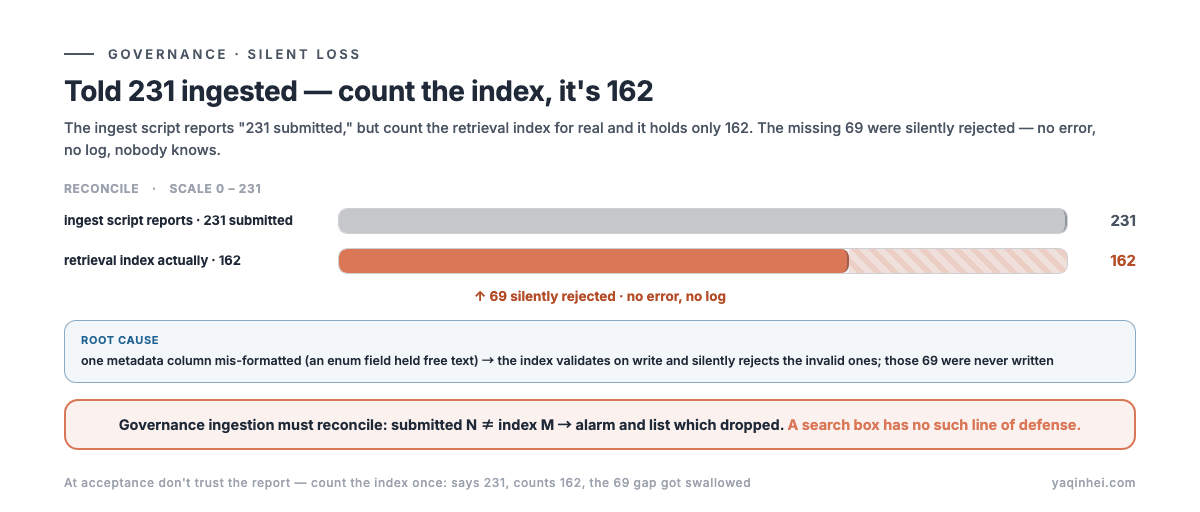
You were told 231 ingested — count the index, it's 162
The acceptance report says "231 items ingested." Count the retrieval index and it's 162. The 69 in between were silently rejected by the retrieval engine because of one mis-formatted metadata column — nothing errored, no log went red.
This is the most chilling pitfall in the piece, because it fooled every stage: the script finished, the report numbers matched, the demo retrieved fine — only counting the index item by item reveals nearly a third missing.
How was it caught? Pure luck. During a spot check, someone asked the agent about a policy that had plainly been written into the knowledge base, and it replied "no relevant information yet." Searching the index for that entry's keywords — genuinely not there. It was one of the 69. Without that offhand spot check, the pretty "231" on the report could have ridden until the next real incident.
Here's how the chain broke: one metadata column in that batch was mis-formatted (a field that should be an enum held free text), the retrieval engine validated against schema on write, and rejected the invalid ones — but the rejection was silent — no error, those 69 simply weren't written. The upstream ingest script only counts "how many I submitted," never doubles back to reconcile "how many the index actually took," so the report cheerfully writes "231" while production can actually retrieve 162. You think you covered all the knowledge; in reality a third of the questions have no matching entry the agent can find, so it falls back or makes something up.
The number-one sin of a governance system is exactly this silent loss. A search box is defenseless by nature: it's accountable for "is it there when you search," not for "did what you thought you loaded actually get in." A real governance service makes ingestion a reconciled step — submit N, go back and count M in the index, and if N≠M, alarm and list which ones dropped, never letting them quietly vanish.
This section's 30-second move: don't trust the ingest report's number, count the retrieval index once. Report says 231, index counts 162, and the 69 in between are what got silently swallowed — a step more honest than any acceptance document.
Detection toolkit: one procurement table + 5 questions to press in the meeting
Flip the four pitfalls over and you get a procurement table — its core admission: retrieval is only the last step of knowledge governance, and the collection, structuring, field backfill, reconciled ingestion, and retirement up front, a search box does none of.
Before you buy a "knowledge center," check off which governance stages it actually covers:
| Governance stage | Search box does it? | Confirm before buying |
|---|---|---|
| Retrieval (surface the doc) | Yes | Demos always retrieve — don't count this as a highlight |
| Judgment / execution (L2/L3) | No | Does your case need order-state-aware conclusions and actions |
| Structuring + routing fields | No | Who backfills the intent/channel fields after the business writes it |
| Quarantine review | No | Can unreviewed entries go straight into the index and get surfaced |
| Reconciled ingestion | No | Says N ingested — can you count N in the index |
| Retirement / expiry | No | How long until a retired policy is actually unsearchable in production |
Then five questions to press, on the spot, in the procurement and acceptance meetings:
-
Does it retrieve documents for me, or give me a conclusion I can act on? Surfacing "policy text" is memory (L1); combining my order's state to judge "refund or not, how much" is hands (L2/L3). Don't buy an L2/L3 need with an L1 demo.
-
From the business writing an entry to the agent safely using it, which processing stages does it pass? "Upload and it's searchable" sells a search box; being able to name who owns structuring, field backfill, and quarantine review is governance.
-
For something not in the KB, does it scrape together the most-similar, or honestly say not found? Retrieval defaults to fail-open; policy settings need fail-closed — "invent a presentable answer" is more dangerous than "I don't know."
-
Says N ingested — take me to count the index. Silent loss is governance's number-one sin; a system where submitted ≠ indexed without alarming means the number you accepted is fake.
-
A retired policy — from the business clicking "retire" to it being genuinely unsearchable in production, how long, through whom? No answer means retirement is ungoverned — a stale line will keep getting quoted as current policy.
What these five share is one move: don't judge "how accurately it searches," judge "beyond searching, which stages of the knowledge lifecycle it governs for you." Accurate search is L1's passing grade, not the thing your project is buying.
Grab this piece's checklist
If you want to put this judgment straight to work on your next procurement and acceptance — without re-reading this piece each time — I've put together a kit for readers who got this far. Reply with the keyword "GOVERN-KIT" and I'll send you Knowledge Center vs. Knowledge Governance: a procurement table + 5 questions to press in the meeting: a one-page procurement table (retrieval / judgment-execution / structuring / quarantine / reconciliation / retirement, checkbox by checkbox), a card version of the 5 pressing questions, and a quick-reference of the four symptoms of "gorgeous demo, can't feed the agent." All judgment tools worn in over a year of agent deployment projects.
Reply channels are in the footer (WeChat / X). If replying isn't convenient, drop your email in the comments.
Building an agent right now?
Send me your worst conversation. Free failure teardown.
Comments
Subscribe
Get the next essay in your inbox.