Anthropic Hired 11 Top People in Six Months. Not One to Build a Product.
In the last six months, these people walked away from seats they'd held for years:
- Andrej Karpathy — OpenAI co-founder, former head of AI at Tesla;
- Jelani Nelson — chair of UC Berkeley's EECS division;
- John Jumper — the mind behind AlphaFold, 2024 Nobel laureate in Chemistry;
- Tom Blomfield — co-founder of the UK challenger bank Monzo, YC partner;
- Peter Bailis — CTO of Workday;
- Harvey Lederman — a philosophy professor at UT Austin who spent the last decade studying a Chinese thinker born in 1472.
Half a year. Eleven people of that caliber. One destination: Anthropic.
Talent flows with direction. When someone at this level closes their own lab, drops a CTO title, takes leave from a department chair, and walks into someone else's shop as a plainly-titled Member of Technical Staff, that isn't random noise. Line up the half-year of hires and sort them by the team they joined, not by who they used to be. What you're holding stops being an HR roster and becomes a map of where Anthropic plans to put its money and people for the next 12–18 months.
The catch: you have to know how to read it. That's what this is about. Anthropic is the worked example; by the end you can point the same method at your own model vendor, your competitor, even your own company's job postings.
First read: go by title alone and you'll mistake a man burning cash on data centers for a payments guy
Tom Blomfield is the easiest of these to misread.
His résumé says "co-founder of Monzo + co-founder of GoCardless" — and GoCardless was just bought by Mollie for $1.1 billion. Payments infrastructure and consumer fintech, top to bottom. Follow the title and the conclusion almost writes itself: Anthropic is moving into agentic payments, into "AI pays for you, AI orders for you."
I read it that way at first too — until I pulled up the team he actually joined. He's in Tom Brown's compute org: data centers, hardware, the physical plant. Not payments, not a consumer product. He's the man shoveling coal into the furnace.
What Anthropic wants isn't his payments knowledge. It's the muscle he built taking Monzo from zero to millions of users and personally raising billions along the way — standing up huge operations and the capital to match. And that muscle has exactly one job to feed right now: in November 2025, Anthropic announced a $50 billion investment in US compute. Fifty billion of capex doesn't need another researcher; it needs an operator who can actually move money and engineering at that scale.
So the first read is simple: team over title. What someone did before decides the headline; which team they joined and who they report to decides what the company wants them for. With Blomfield under compute, Anthropic's intent flips from "building payments" to "it treats burning cash on compute as a first-order job worth hiring a top operator to run."
One field of data, and the whole roadmap reads in reverse.
Sort the eleven by team and only four pillars are left
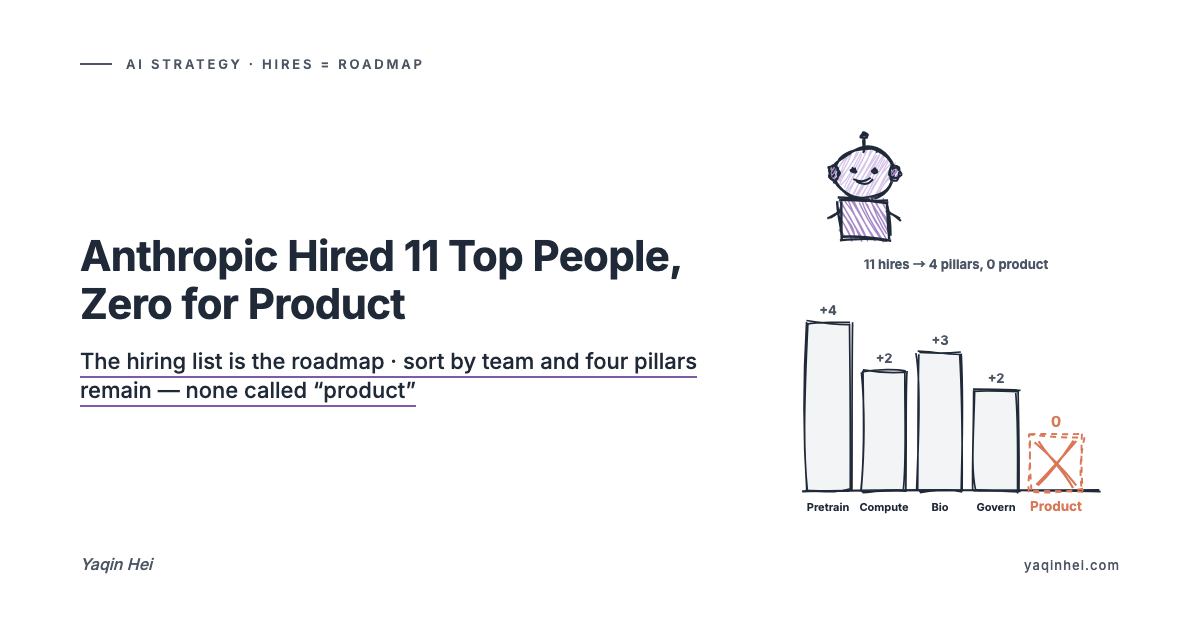
Run that read across all eleven and one thing surfaces: hiring that looks scattered across six directions collapses, once you sort by team, onto four pillars — and not one of them is called "product."
- Pillar one: AI building AI + pretraining efficiency. Karpathy and Jelani Nelson, both in pretraining.
- Pillar two: compute. Ross Nordeen and Tom Blomfield, both in the compute org.
- Pillar three: science, biology above all. John Jumper and Kirill Neklyudov, plus a $400 million acquisition.
- Pillar four: the soft power of governance and economics. Harvey Lederman and Chad Jones.
The two who look like "product / retrieval" fold into the engine itself. Bryan McCann (You.com co-founder, ex-Salesforce researcher) works on retrieval — the pipe that feeds the model. Peter Bailis (ex-Workday CTO) went in to do reinforcement learning engineering — the hand that trains the model. Nobody was sent to build a user-facing product skin.
The four directions a company fights hardest to staff are the four squares where its chips are stacked highest. Below, pillar by pillar, each with one read you can carry off.
The two strongest people are both pushed onto "AI building AI"
Pillar one is the main engine, and the signal is loudest here, because the two people stacked on it are as high-caliber as hiring gets.
Karpathy is in pretraining, reporting to Nick Joseph, with a very specific mandate: stand up a sub-team studying how to use Claude to accelerate Claude's own pretraining. In plain terms — let this generation of models act as the researcher training the next. Recursive self-improvement (RSI: models improving models, spinning the research loop by itself). For five years that word named the capability safety researchers watched most closely. Now it's the KPI of a team.
Right after, on July 1, Jelani Nelson took leave from the Berkeley EECS chair and joined the same pretraining line. His specialty is streaming algorithms and dimensionality reduction — a whole theory of squeezing every last unit of resource out of a fixed memory and compute budget.
Put the two together and Anthropic's read is clear: it doesn't think pretraining has hit a wall. It's betting on efficiency — the same chips squeezed harder, the model standing in for a researcher on part of the loop. The flywheel starts to turn on its own. Karpathy makes AI take over the research loop; Nelson pushes the floor of compute efficiency down. Together they turn "the compounding flywheel of recursive self-improvement" from a slide slogan into two real teams with real budgets.
There's a more expensive read hidden here: which direction a company will pay a "top-talent premium" for. Hiring ten capable engineers means a direction is scaling up. Hiring one Karpathy — and standing up a team around him — is something else entirely: that direction has been made a bet-the-company line. The more absurd the premium, the stronger the signal.
It's building and renting at the same time, treating compute as a lifeline
Pillar two is compute, and there's a spot here that's easy to half-misread, worth prying open.
Ross Nordeen co-founded xAI and was the last co-founder besides Musk to leave it, after three years on supercomputers at Tesla before that. He joined Anthropic's compute team on a telling day — almost the same day Anthropic closed the deal to rent xAI's Colossus supercluster (300+ megawatts of compute).
Look only at Nordeen plus Blomfield and it's easy to land on "Anthropic is going big on self-built compute, done relying on partners." But read the deals together and the truth is more interesting: it's running both paths at once. On one side, the $50 billion announced in November 2025 to custom-build data centers with Fluidstack in Texas and New York. On the other, renting SpaceX / xAI's Colossus directly — and Nordeen came in alongside that rental deal.
The accurate read, then, isn't "abandoning partners for self-build." It's build and rent, bet on many fronts, treat getting enough compute as the company's lifeline. At this stage compute is ammunition: build what you can, rent the rest, lock in the long contracts wherever they're on offer. Another frontier lab has formally stepped into the arms race for power, chips, and capex.
Compute has crossed a line here: it's gone from a procurement item to a lifeline worth guarding yourself — worth standing up a team around the word "infrastructure" and hiring a top operator to hold it.
Paying $400M for 10 people is really about that wet lab
Pillar three, science and biology above all, is the heaviest bet on the list.
John Jumper is the mind behind AlphaFold, shared the 2024 Nobel Prize in Chemistry with Demis Hassabis, spent nearly nine years at DeepMind, and announced his departure on June 19. Anthropic hasn't disclosed his exact title, but the direction needs no guessing. Add Kirill Neklyudov — an MTS on leave from Mila / Université de Montréal, whose specialty is generative modeling for protein folding and molecular dynamics.
The part of this pillar to look at closely, though, is the acquisition. In April 2026, Anthropic bought Coefficient Bio for roughly $400 million, all stock. The team is fewer than ten people, most of them former Genentech computational biologists.
$400 million for ten people looks insane on the number alone. But the real signal in an acquisition is hiding in where it deploys the people it keeps. What's valuable in Coefficient is the capability in their hands: wiring AI-generated molecular designs straight into a wet lab for real experimental validation. It lets AI draft drug-discovery plans, run the validation, and feed the results back into the model.
The digital-layer work — models reading literature, computing protein structures — Anthropic already had. What it lacked was the "digital → physical" link: taking a model's idea into a lab, running the experiment, and feeding the result back. Buying Coefficient closes exactly that link. It's a serious, complete AI-for-bio loop, chasing the same jewel DeepMind is after. The frontier labs are walking into the physical layer of the life sciences.
Hiring a philosopher who studies Wang Yangming isn't a PR move
Pillar four is soft power, the one most easily waved off as decoration. It shouldn't be.
Harvey Lederman, philosophy professor at UT Austin, spent the last decade mainly on Wang Yangming — the Ming-dynasty thinker born in 1472 whose central idea is the "unity of knowledge and action." At Anthropic he works on alignment and character. Hiring someone who studies Wang Yangming to teach a model how to understand values and keep its internal beliefs from fighting each other is treating "what character a model should have" as a real problem — not hanging a nice sign.
The other is Chad Jones, a Stanford economist of seventeen years known for semi-endogenous growth theory, who joined the newly formed Anthropic Institute — led by co-founder Jack Clark and researching AI's systemic impact on growth, employment, and the rule of law.
Together they sketch one role: the responsible gatekeeper. This line doesn't make money directly; it earns a voice, using safety and governance research to hold the high ground in the debate over how frontier AI should be governed. It's the same play as Demis Hassabis's essay on a framework for frontier AI: whoever writes the language of the rules first gets a head start in the next round of regulation.
Don't file "governance / ethics" hires under PR budget. When a company will pay Nobel-, chair-, full-professor-level people for this line, what it's buying is a front-row seat when the rules get written. Good reputation is just the bonus.
What it hired for matters less than what it didn't
The four pillars all read "who it hired." The more seasoned read goes after the negative space — the directions it clearly had the money and prestige to hire for, and hired for none.
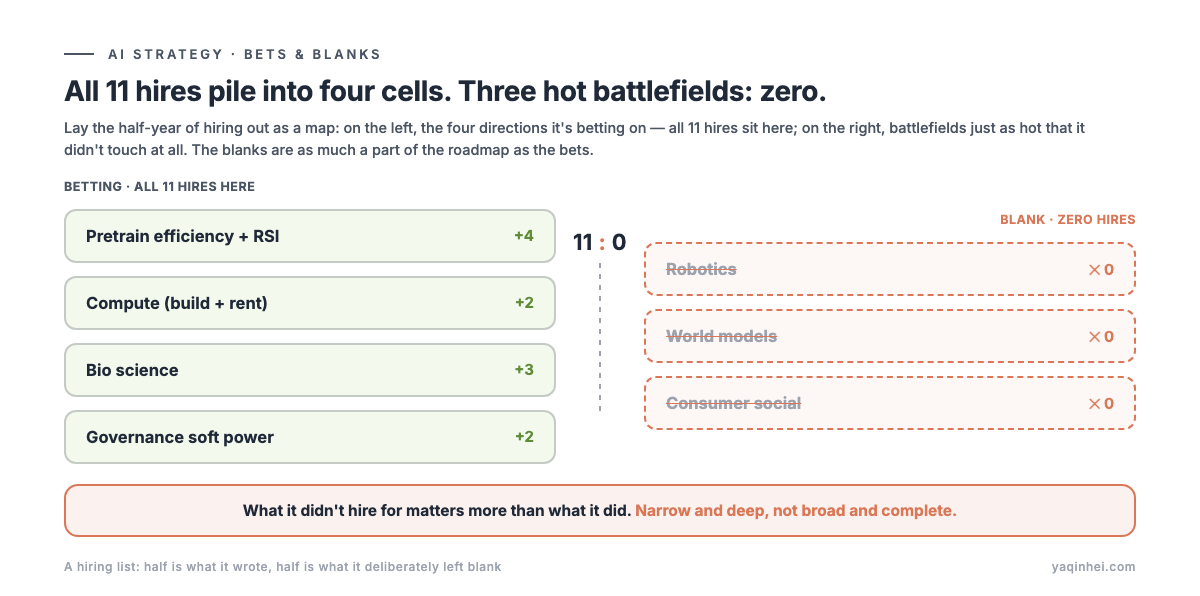
Read the roster through and several of the hottest directions in the field got nothing from Anthropic:
- Robotics — none.
- World models — none.
- Consumer social / on-device entertainment — none.
(For the record: this is my read of the public roster, not an official statement. But systematically skipping a direction across eleven hires in six months is itself a signal.)
A company's hiring says both "I'm going here" and, silently, "I'm not going there." While the field fights over robotics and world-model people, Anthropic stacked its top chips into pretraining efficiency, compute, biology, and governance. It has heard of those other directions, of course. It just chose to go narrow and deep instead of broad and complete.
That's the last read, and the most counterintuitive: half a hiring list's value is what it wrote, and half is what it deliberately left blank. People who can read it read both sides.
Point this method at your own vendors and rivals
Back to the opening line: hires are the roadmap. What this piece actually wants to hand you isn't the gossip conclusion "here's what Anthropic is up to" — it's the moves that produced that conclusion, because those moves you can use on someone else tomorrow.
Next time your model vendor posts a batch of roles, or a rival makes an acquisition, don't stop at the titles. Run these steps:
- Team, not title. Which team someone joined and who they report to says more about what the company wants than who they used to be (Blomfield sits under compute, not product, and the read flips entirely).
- Watch who earns the "top-talent premium." Ten engineers is scaling; standing up a team around one person is betting the company. The more absurd the premium, the surer the main line.
- On acquisitions, read the people, not the price. $400 million bought that wet-lab link, not a ten-person team.
- Read the negative space. The direction it could hire for and didn't is the battlefield it chose to abandon; silence is as much a signal as an announcement.
Applied to Anthropic, those four steps sketch a company going narrow and deep: main engine on pretraining efficiency + RSI, a serious biology vertical, compute treated as a lifeline and both built and rented, plus governance and economics holding position. It isn't loading up on robotics, world models, or consumer social. It's digging down, not spreading out.
Take the same four moves and read the company closest to you.
Send me the keyword "ROADMAP KIT" and I'll send this detective's method as a one-page checklist: the four-step read plus a "sort-by-team" table template, so the next hiring or acquisition announcement, you can fill it in and infer where they're betting.
Channels in the footer — X or email both work.
Building an agent right now?
Send me your worst conversation. Free failure teardown.
Comments
Subscribe
Get the next essay in your inbox.